
Meta is changing how advertising learns across its platforms
Its latest GEM update reinforces the value of a clear commercial goal, useful customer signals and distinctive creative.
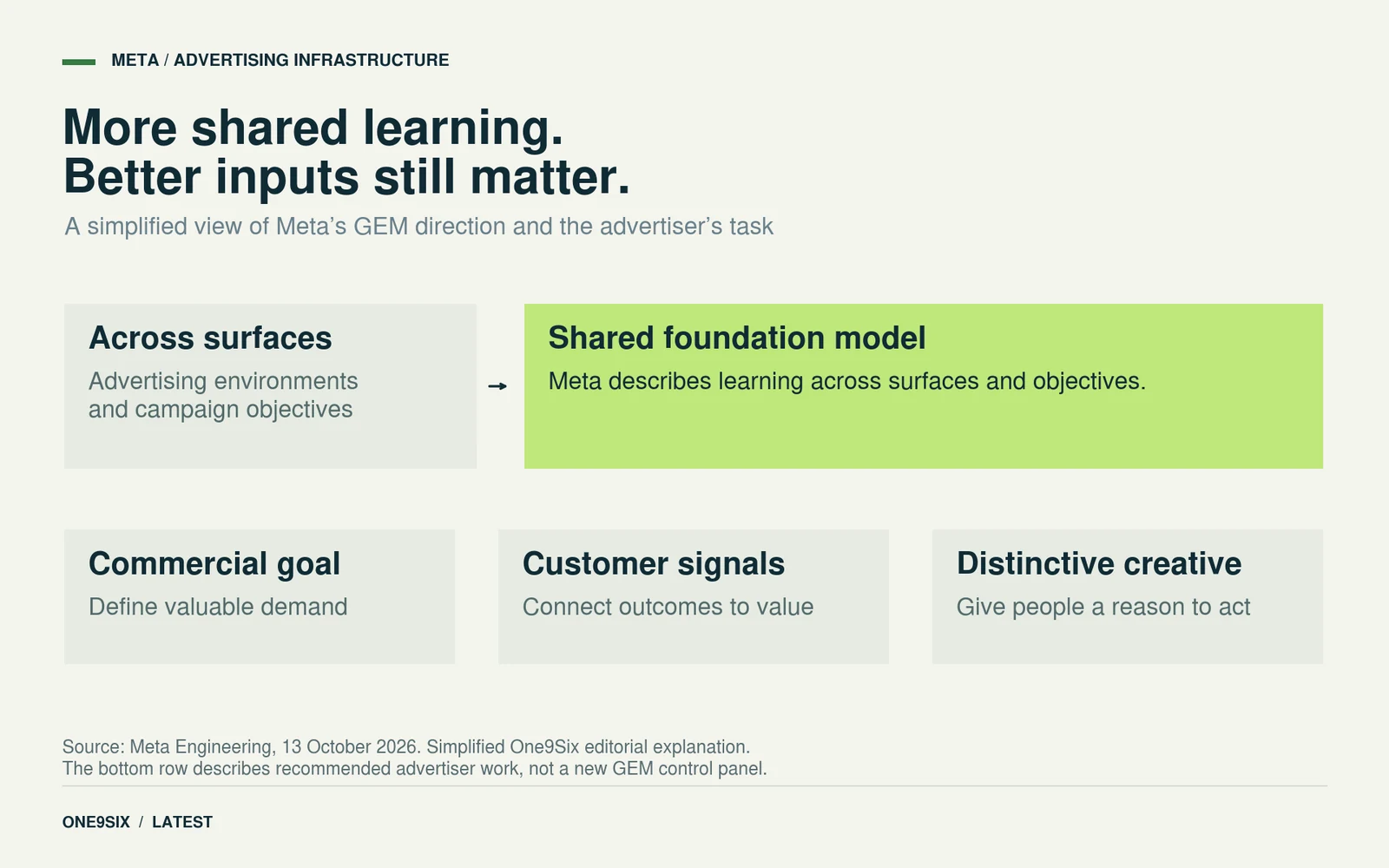
Meta's 13 October engineering update describes a new generation of its Generative Ads Model, GEM. The company says it is moving from separate optimisation across individual advertising environments towards a shared foundation model that learns across surfaces and objectives. Its reported performance improvements are platform findings, not a forecast for an individual advertiser. GEM is infrastructure behind advertising recommendations, rather than a new campaign switch a marketing team can simply turn on. [Sources]
The practical question is how a business helps an increasingly automated system distinguish valuable demand from activity that merely looks encouraging. That starts with the outcome being requested and the information the advertiser can supply about it.
The One9Six view
We would review the campaign brief before making assumptions about account structure. A request for more enquiries can hide several different priorities: a particular industry, a higher-value product, a geographical expansion or a shorter sales cycle. Agreeing the priority gives the creative and measurement work a common direction.
The next task is to give the campaign genuinely different reasons for a customer to respond. A demonstration, a specific use case and an answer to a purchasing concern test different parts of the proposition. Changing the background colour on the same vague claim adds little to that understanding. We would build a manageable set of concepts around the actual product and the objections the sales team hears.
Each concept should connect to a destination that fulfils its promise. A technical buyer may need specifications and application examples. A hospitality prospect may need availability, inclusions and a clear way to enquire. The campaign becomes easier to evaluate when the advertisement and the destination are designed for the same decision.
We would then compare creative performance with enquiry quality and subsequent sales progress, making changes in a way that preserves a useful comparison. The aim is to learn which proposition attracts the right customer, and whether the business can convert that interest effectively.
Meta's engineering direction is a reason to improve those controllable inputs. It is not a reason to promise that a model update will fix an undifferentiated offer. A stronger brief, clearer evidence and a consistent customer journey remain work the advertiser can commission and assess.
Sources
- Meta’s Generative Ads Model scales frontier ads AI ↗13 October 2026
Sources checked 4 November 2026. News and research are attributed above; the application to clients is One9Six’s analysis.