
Silence is a decision your business needs to be able to explain
Ipsos finds senior communications leaders becoming more selective about public positions. The choice still needs a clear business rationale.
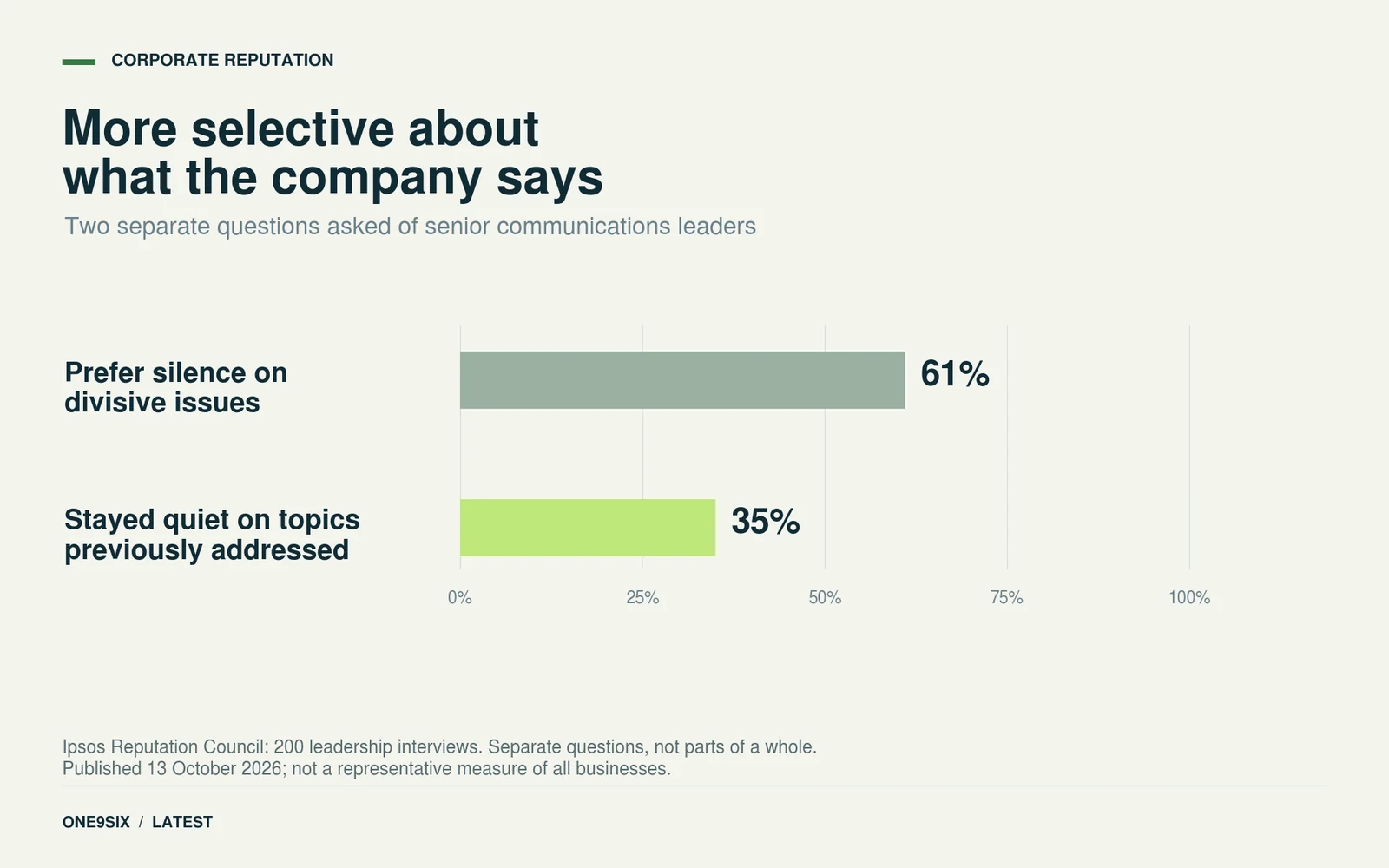
Ipsos's Reputation Council report, published on 13 October, describes a more cautious approach to corporate speech. Among the senior communications and corporate affairs leaders interviewed, 61% preferred to avoid divisive issues even when their organisation could credibly contribute. Some 35% said their organisation had remained quiet on issues it would previously have addressed. The research reflects 200 leadership conversations, rather than a representative survey of every type of business. [Sources]
The finding raises a practical question for management teams. When an issue reaches employees, customers or policymakers, what makes it the company's responsibility to respond? That answer should come from its activities, commitments and exposure. A growing online argument alone is a poor substitute for understanding whether the company has something useful and defensible to say.
A position should survive the next question
Our view is that the quality of the decision matters more than its volume. Before making a public statement, a company should be able to explain the connection to its business, the people affected and the action it is prepared to take. It also needs to know what evidence might contradict its account. A carefully worded statement cannot repair a promise that operations are unable to fulfil.
Equally, a choice to remain quiet can leave employees or partners without information they need. A broad public intervention, a direct customer explanation and an internal briefing are different decisions. An organisation may have good reasons to avoid entering a public dispute while still explaining its own policy to the people who depend on it. That distinction can keep a manageable question from becoming an unnecessary confrontation.
What we would prepare with the client
For a business operating across several countries, One9Six would prepare a short position brief around the issues most likely to affect its operations. Each brief would name the decision owner, the relevant facts, the company's existing commitments and the circumstances that would require a response. We would prepare the spokesperson for the strongest reasonable challenge, including questions that expose differences between the corporate position and local practice.
The immediate deliverable is a usable decision and a prepared explanation for the relevant audience. Success might mean a timely statement, a direct conversation or an informed choice to say less. It should never be measured simply by the number of contentious topics a company joins.
Sources
- Ipsos Reputation Council Report 2026 ↗13 October 2026
Sources checked 4 November 2026. News and research are attributed above; the application to clients is One9Six’s analysis.