
Change programmes need answers employees can use
Edelman's latest workplace research gives employers a reason to examine what staff hear before, during and after a major change.
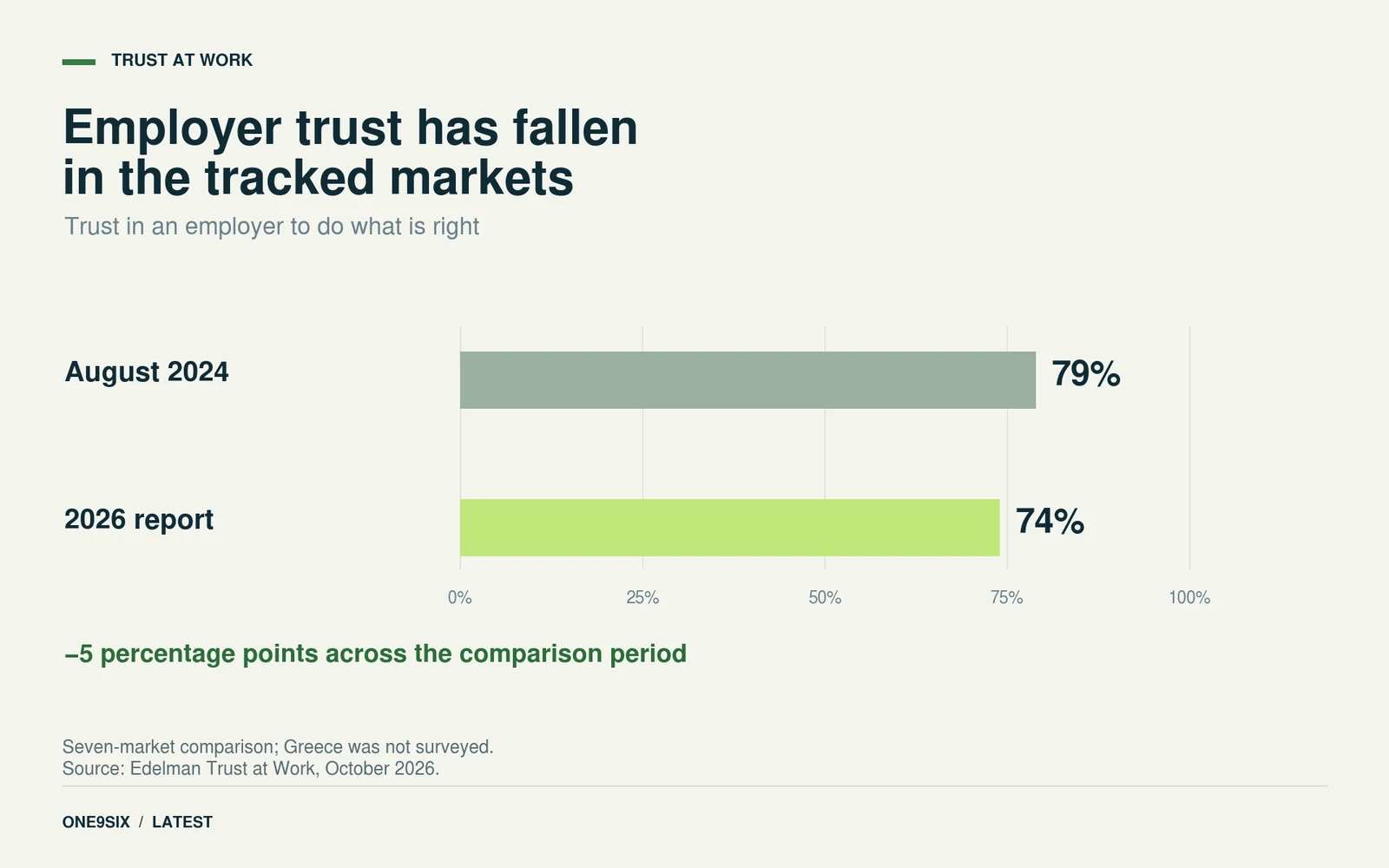
Edelman's Trust at Work report, released on 5 October, puts employee experience at the centre of organisational change. Its comparison across seven tracked markets shows trust in employers falling from 79% in August 2024 to 74% in the 2026 report. The underlying research surveyed 10,018 employees across ten countries, with the published analysis focused on people working for organisations. Greece was not included. [Sources]
A change programme creates an immediate information problem. Leadership may be discussing competitiveness, integration or investment while employees are trying to establish what happens to their role, workload or reporting line. Both conversations concern the same decision, but they operate at different levels. A polished announcement can leave the practical questions untouched.
The manager needs the answer before the meeting
Our view is that internal communication should follow the decisions employees need to make. What changes now? What remains undecided? Who can resolve a question about an individual situation? When will the next reliable update arrive? Giving a precise date for an answer is often more useful than repeating reassurance that nobody can substantiate.
Managers need time to understand the announcement before they are expected to explain it. They also need a route back to the people who own the decision. Otherwise, a question that exposes a real operational gap can be misclassified as resistance or handled differently by every team. The communications process should make that gap visible early enough for management to address it.
How One9Six would structure the communication
For an international company introducing a new operating model, we would develop the leadership explanation alongside a practical manager brief and a carefully maintained employee question log. A broadcast or town hall would provide the main account, with local-language material explaining what it means for each location. The executive speaker would prepare for unresolved questions as well as the confident parts of the story.
After the announcement, the work would continue through dated answers, useful examples and explicit ownership of outstanding issues. We would look for recurring misunderstandings and unanswered operational questions, rather than treating a high video view count as evidence of understanding. The aim is to help people act with better information while keeping commitments realistic; communication cannot substitute for decisions on staffing, training or workload.
Sources
- Edelman Trust at Work 2026 report ↗5 October 2026
- Edelman Trust at Work 2026 methodology and findings ↗5 October 2026
- Edelman report library publication record ↗5 October 2026
Sources checked 4 November 2026. News and research are attributed above; the application to clients is One9Six’s analysis.