
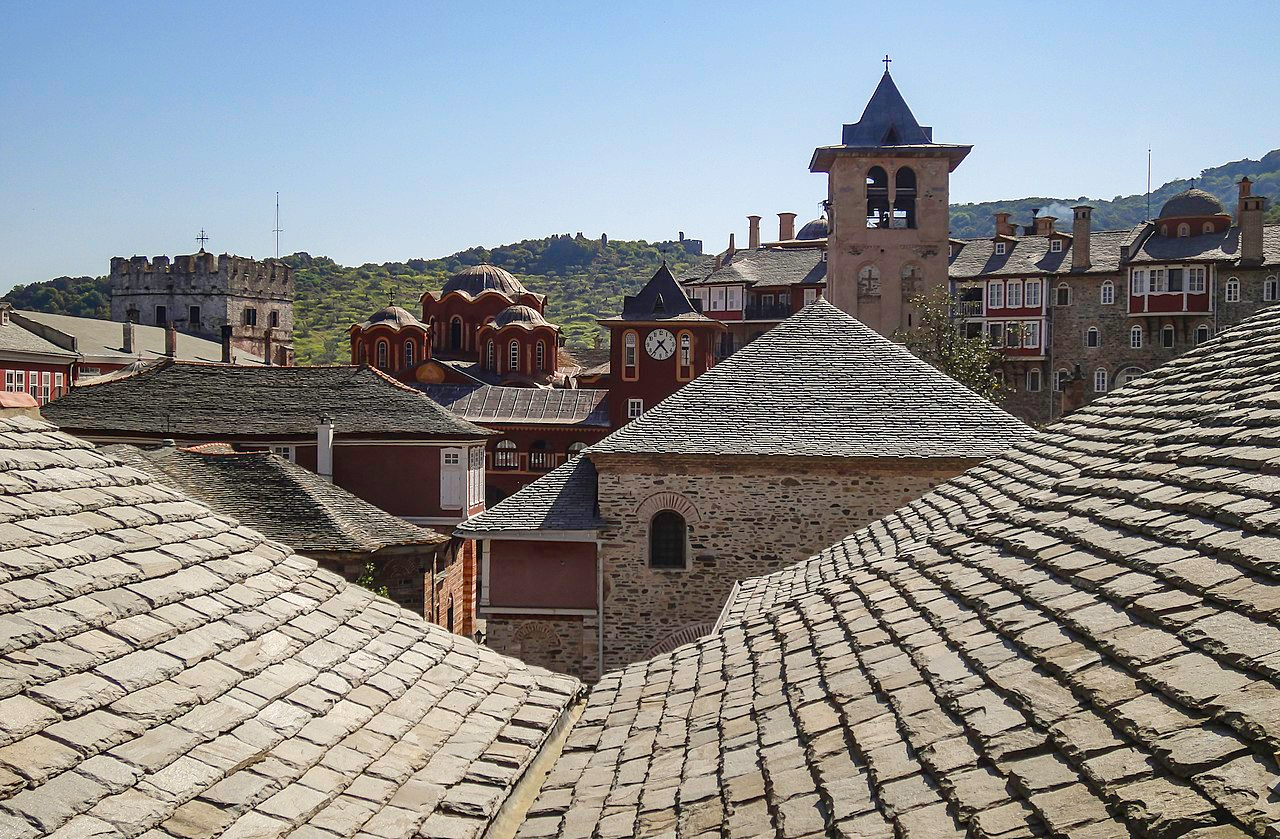


Farming as part of monastic life
Mount Athos is home to 20 monasteries. For centuries, their monks have tended vineyards, olive groves and gardens. Farming remains part of monastic life and has shaped the peninsula’s landscape. UNESCO’s World Heritage documentation links traditional farming and forestry to the preservation of local habitats and plant life. Organic certification is also documented for individual producers on Mount Athos. UNESCO World Heritage documentation · Organic certification example
At Vatopedi, cultivated fields and olive groves sit close to the monastery. The olive mill still standing near the shore dates to the second half of the 19th century. An inscription from 1319–20 records work on an earlier press. These sites show how closely growing and processing food have been tied to monastic life. History of Vatopedi’s olive mill


Why eligibility mattered
To access direct payments under the Common Agricultural Policy, a farm operator had to qualify as an active farmer. For the monasteries, the question was how agricultural work carried out within a religious institution could count towards that status. The 2019 decision gave qualifying monasteries a clear basis for recognition, tied to the land they cultivated and the agricultural revenue it generated.
Our role
One9Six supported the case for taking the monasteries’ agricultural activity into account under Greece’s Common Agricultural Policy eligibility rules. The case for fair treatment was straightforward. The work already taking place on the land should be assessed against clear, verifiable criteria for cultivation and agricultural revenue. It was an honour to work with the monastic community on that effort.
What we achieved
One9Six helped secure a 2019 policy change that allowed Mount Athos monasteries meeting the cultivation and agricultural revenue criteria to be recognised as active farmers for direct Common Agricultural Policy (CAP) payments. Joint Ministerial Decision 4404/2019, Government Gazette B΄ 3494/18.09.2019


Explore our public affairs work ↗
The policy question in detail
Make agricultural activity visible within the rules.
The case connected a longstanding agricultural reality with a specific policy definition. Monastic identity and agricultural activity had to be understood together, so the discussion could focus on objective criteria that public administration could assess.
The real activity
Cultivated land and the agricultural revenue associated with it gave the policy discussion a verifiable basis.
The policy definition
Recognition as an active farmer was the eligibility question. The institutional form of the operator had to be considered alongside the substance of its agricultural work.
The public affairs contribution
One9Six supported the case for recognising that activity through clear cultivation and revenue criteria. The published decision provides the documentary reference for the policy change.
The documented 2019 framework
A defined basis for recognition.
Decision 4404/2019 expressly included Mount Athos monasteries meeting the specified agricultural conditions. The criteria below describe that historical decision.
Minimum cultivated area, equivalent to 5 hectares.
Agricultural revenue had to exceed this amount, on an actual or imputed basis under the decision.
Published in Government Gazette B΄ 3494 on 18 September.
The change concerned recognition for eligibility. It does not establish that every monastery received a payment.
Read the published decisionThe wider relevance
Policy definitions shape practical possibilities.
This assignment illustrates a particular form of public affairs: connecting the real activity of an institution with the criteria through which that activity is recognised. The value lies in a well defined issue, a documented case and an outcome that can be traced to a public decision.