
Your images need a history as well as a caption
WordPress's AI plugin has begun detecting image credentials. Publishers still need to understand what the record does and does not establish.
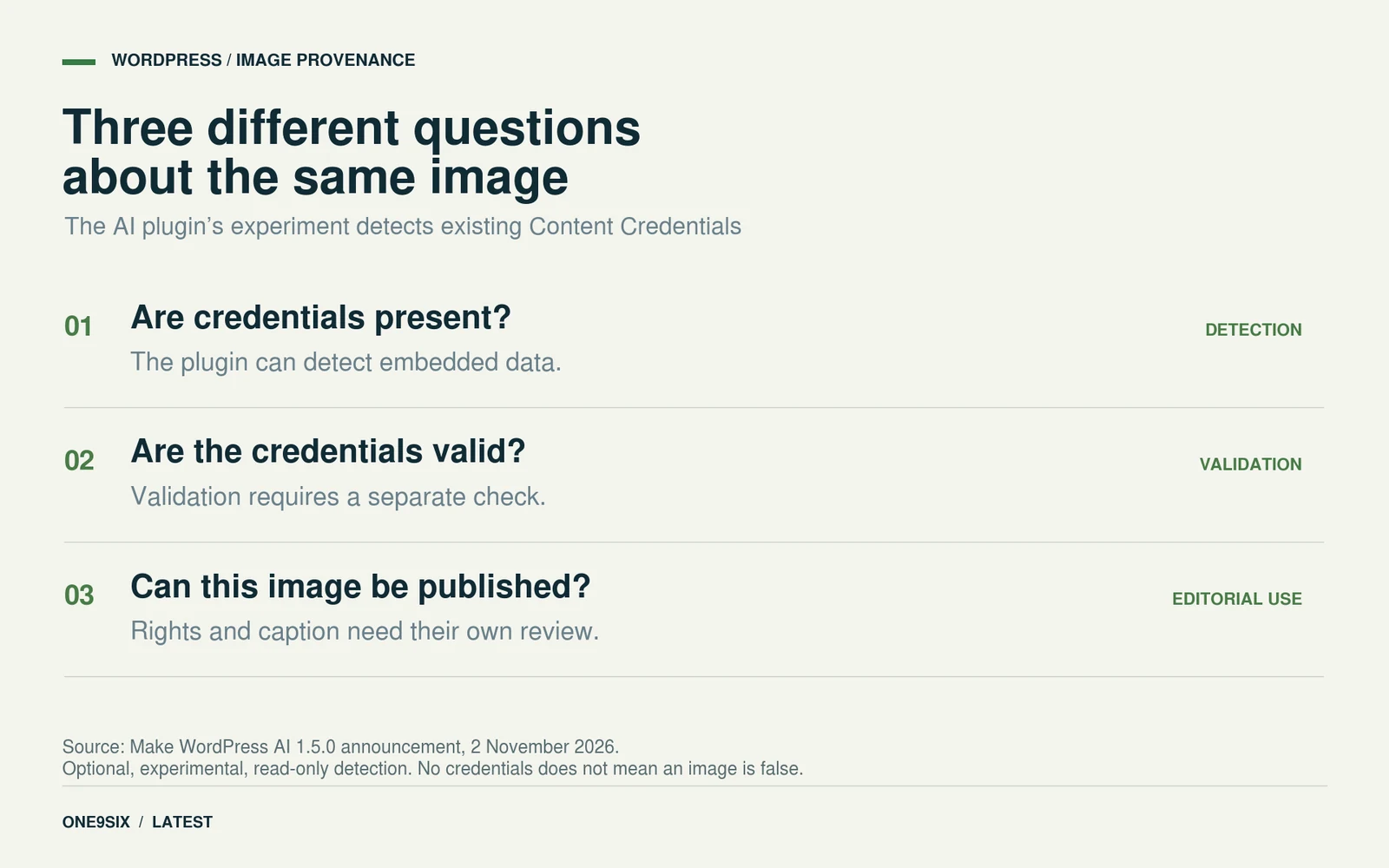
WordPress's AI plugin version 1.5.0, released on 29 October and described in a 2 November announcement, introduces an experimental way to detect existing C2PA Content Credentials in uploaded images. It supports JPEG, PNG and WebP files and displays an indicator in the Media Library. This is read-only detection: it does not create credentials or cryptographically verify them. It is an optional plugin experiment, rather than a feature automatically active on every WordPress site. [Sources]
The useful development is that information about an image's history is moving closer to the everyday publishing workflow. A communications team can increasingly encounter it while selecting and preparing material, rather than treating provenance as a specialist question raised only after a dispute.
A trustworthy record needs editorial context
Our view is that publishers should preserve the original file and the information that explains its use. Who supplied the photograph? Which event does it show? When was it taken? What editing has been applied, and what permission covers publication? The answers should remain attached to the working record even when the website uses a smaller, compressed version.
Credentials can contribute to that record, but their presence does not establish that a caption is accurate or that an image supports a particular claim. A photograph from the wrong year can still be misleading. A genuine image can be placed beside a description of work its subjects did not perform. Editorial judgement remains necessary at the point where the image and the story meet.
How One9Six would use this in publishing
For a client case-study programme, we would retain original photography, record the project and date, and link each selected image to its source and permission record. The published caption would explain the relevant context without implying that every person or activity in the frame belongs to the agency's assignment. Optimised web copies would be derived from that controlled set.
If the client's publishing stack supports the experiment, we would test it in a safe review environment before deciding whether it adds useful information to the team's existing process. The immediate improvement does not depend on installing a new feature. A well-kept image record, accurate caption and traceable approval already make the next update easier to produce and defend.
Sources
- WordPress AI 1.5.0 release announcement ↗2 November 2026
- Official WordPress AI changelog ↗29 October 2026
Sources checked 4 November 2026. News and research are attributed above; the application to clients is One9Six’s analysis.