
AI design tools make the approved master more valuable
Canva's October releases expand generation and editing. Their useful role begins with a clear creative brief and a reliable brand source.
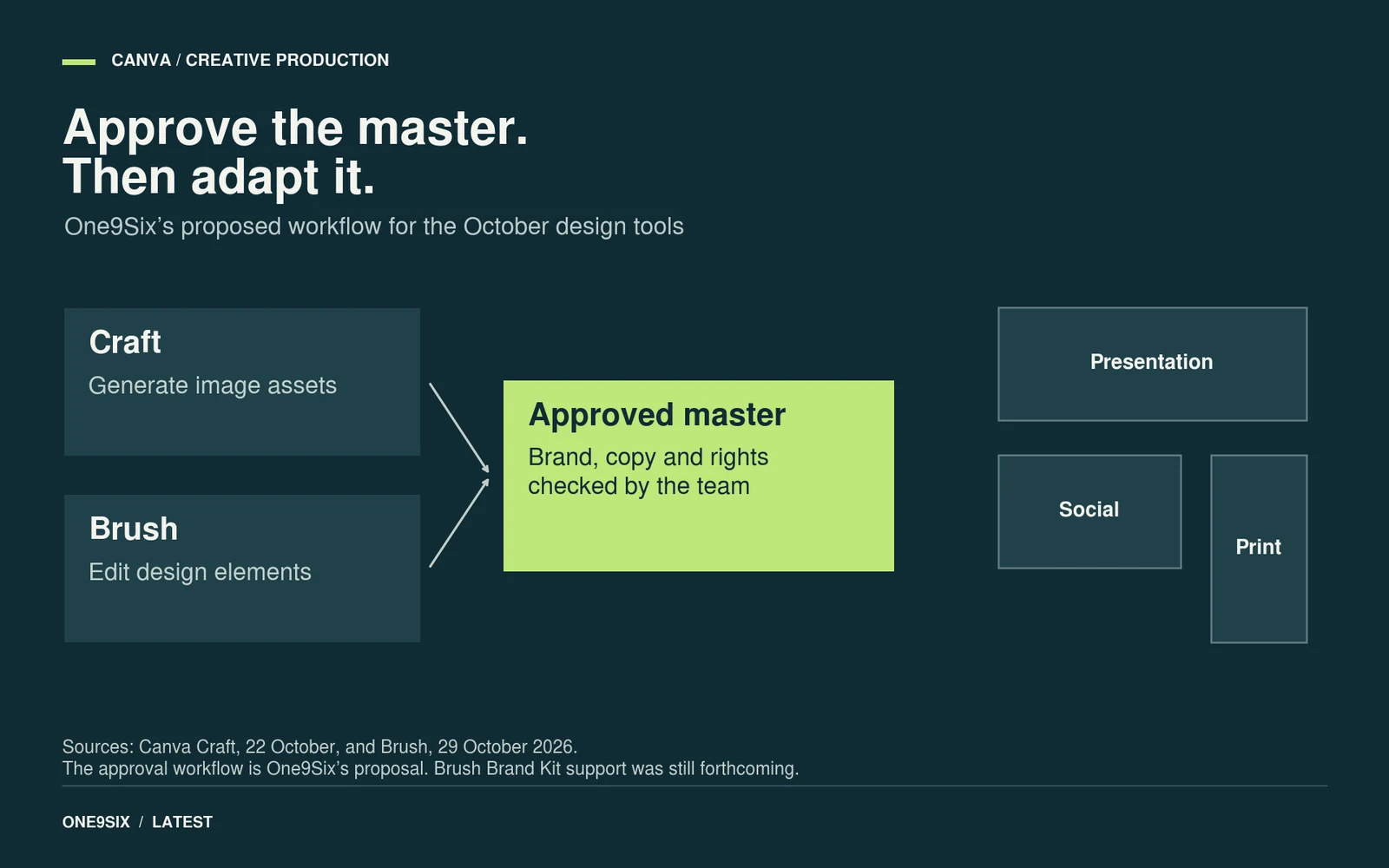
Canva introduced its Craft image model on 22 October and Brush, a design-editing model, on 29 October. Brush supports edits within Canva AI for Pro subscribers and leaves the resulting design editable. The launch announcement also says Brand Kit support is still being developed. That distinction matters: a tool capable of changing a layout should not be assumed to enforce a company's brand rules automatically. [Sources]
For a marketing team producing many formats, the opportunity lies in reducing repetitive adaptation. The risk is multiplying an error as quickly as a useful idea. An incorrect logo, unapproved claim or weak translation can travel across a campaign if the original design has not been settled first.
Start with the version worth repeating
Our view is that the master creative becomes more important as adaptation gets easier. It should establish the hierarchy, approved wording, actual product photography and the rules for using partner identities. Those decisions belong in an editable source that a designer can inspect. A beautiful flattened image is a poor handoff when the next requirement is a changed price, a Greek headline or a different product.
There is also a difference between exploring a visual direction and documenting something real. Generated imagery can help test an illustrative concept. A client installation, venue, product specification or event record needs the appropriate real material. Keeping that distinction clear protects the usefulness of the creative as well as the credibility of the campaign.
How One9Six would apply it to a campaign
For a distributor preparing a product campaign, we would approve one master using the genuine product files, correct supplier logos and agreed commercial language. We would then test whether assisted editing can adapt that master to the required social, presentation and landing-page formats without changing its meaning. Greek and English text would remain separately reviewed, with real type wherever practical rather than text baked into generated pictures.
The first trial would compare time to an approved final asset, including corrections and export checks. It would also record which changes still require direct design work. That gives the client a useful production decision based on its own material, rather than borrowing a vendor's speed claim and presenting it as a guaranteed saving.
Sources
- Canva introduces Brush ↗29 October 2026
- Canva introduces Craft ↗22 October 2026
Sources checked 4 November 2026. News and research are attributed above; the application to clients is One9Six’s analysis.